
What Plymouth taught senior leaders about place-based collaboration at scale

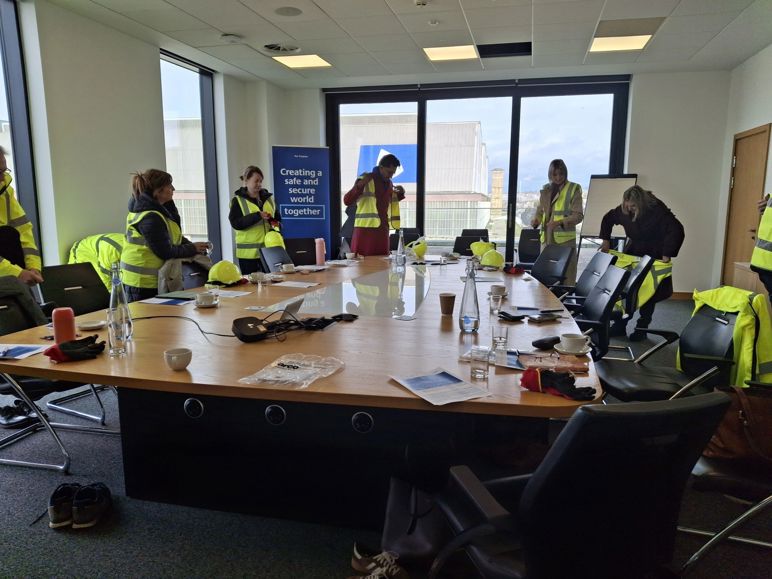
In March 2026, WIG's Advanced Collaborative Leadership Programme (ACLP) brought together a cross-sector cohort of senior leaders from government, business, health, and civil society at Devonport, Plymouth, for an immersive day within a place-based collaborative ecosystem with a long-term investment.
The yearly open-enrollment leadership programme brings together a cohort of senior leaders from across sectors to enhance their ability to work in partnerships to solve complex challenges and create impact towards economic growth and prosperity in the UK.
Learn more about applying for this year's ACLP cohort.
This module's host was Babcock International Group, which owns and operates the dockyard at one of the oldest and largest naval bases in Western Europe and is one of the city’s largest employers. The leaders were keen to see what collaborative leadership looks like in a large-scale, place-based setting. This was of particular interest, given a programme of national importance, a mission spanning a decade, and the strategic role of cross-sector partnerships.

Why Plymouth, Why Babcock?
Devonport is where Babcock maintains and overhauls ships and submarines on behalf of the Royal Navy, including the vessels that support the UK's Continuous-At-Sea Deterrent. Babcock owns and operates the dockyard and supports the Ministry of Defence as an industry partner in delivering defence outputs. Babcock contributes £1.3 billion annually to the South West's GDP, supports over 300 firms in its regional supply chain, and runs one of the largest early careers programmes in the region.
Through Team Plymouth, a formal partnership with Plymouth City Council, the MoD and civic partners, Babcock is also trying to demonstrate that defence investment and community prosperity reinforce each other rather than trade off.
As Trevor Cayless, Director at Babcock International, put it:
"Devonport is not a single organisation, but a connected ecosystem. Welcoming a cross-sector cohort prompted fresh questions and challenged us to explain not only what we do, but how and why collaboration underpins successful delivery. We wanted senior leaders to leave with an appreciation of the scale and intentionality required to deliver both operational and economic outcomes."
Mission clarity that runs all the way down
The word that came back most consistently from participants after the visit was authentic. People at every level, from senior leaders presenting the strategic vision to engineers and apprentices, were visibly driven by purpose and outcomes in day-to-day performance. Governance and accountability structures were clear and well understood at every level, enabling clarity of purpose and rapid decision-making.
The participants identified this as Babcock's most transferable leadership principle: mission clarity as a management system. When everyone in an organisation understands not just what they are doing but why it matters, at national, regional, community, and individual levels, accountability becomes self-sustaining rather than imposed. Underpinning all of it was a culture in which shared mission visibly overrides organisational self-interest.
Meeting people where they are
The visit included a session at the Foulston Park Community Hub in the heart of Devonport, a multi-agency space delivering health and wellbeing support, skills training and employment pathways to the local community, run in partnership with Babcock, Plymouth Argyle Football Club, the local council and health services.
The cohort learnt that communities were active participants in shaping the solution, not passive recipients of a service. Their operating principle is simple but instructive for any leader designing services, partnerships or change programmes: meet people where they are, not where you need them to be. A resident could initially engage by using the gym, and over a period, they might also benefit from employment support or skills training they might never have sought out elsewhere.
The University of Plymouth extended that principle beyond the skills pipeline itself: VR simulation labs, joint curriculum development with Babcock and applied research across the region's industrial base, showing what it looks like when an academic institution functions not just as a skills pipeline but also as a long-term strategic partner embedded in the economic and workforce future.
Taken together, what the cohort witnessed across both stops was cross-sector collaboration that felt genuinely embedded rather than bolted on: impact visibly achieved through long-term investment in relationships and local ecosystems rather than campaign-led initiatives. It prompted participants to examine their own community engagement and partnership models: are we leading with trust and shared goals, or are we leading with our own institutional convenience?
Anchor institution thinking: The NHS parallel
For Tony Mears, a senior NHS leader in the ACLP cohort, the Plymouth model resonated directly with what health systems call anchor institution working: the Marmot principle that the conditions shaping people's health, including employment, education and economic security, are more powerful determinants than healthcare delivery itself.
"I did feel convinced," Tony reflected. "It felt like this was central to their approach: a long-term workforce pipeline, embedding local prosperity as being in everyone's interest, rather than playing a zero-sum game for resources. The long-termism is the bit I'm trying to adopt."
He is already acting on it: convening the CEOs of large anchor organisations in his geography to explore what a coordinated, long-term approach to place-based prosperity could look like in an NHS context.
But Tony also left with some questions: "The personal passion for place shone through. I'm working out how you replicate the results when that personal buy-in might not be there, and what this looks like in a diffuse rural geography rather than a concentrated city like Plymouth."
From operations-led to capability-led
The longevity of Babcock's pipeline of work and contracts enables something the cohort found genuinely instructive: a shift from an operations-led to a capability-led model, where workforce development, relationship investment, and long-term planning are given strategic priority.
That shift is visible in how Babcock approaches the talent pipeline itself: pre-apprenticeship pathways, gamified recruitment processes designed to remove traditional barriers to entry, and VR simulation training that makes high-stakes skills development accessible to a far wider range of learners.
Most organisations represented in the cohort operate under shorter planning cycles, shifting priorities, regulatory uncertainty and market disruption that make that shift difficult. But the challenge itself, asking whether your organisation is optimising for today's needs or building the capability that tomorrow's delivery requires, was identified as immediately applicable regardless of sector or contract length.
Trevor Cayless captured the spirit of what the day was designed to offer:
"We talked openly about the challenges of leading in complex environments: working with partners as diverse as national and local government, the military, industry, education providers and the third sector. We hope we were able to convey how rewarding this collaboration can be, and the tangible difference it makes to the long-term prosperity and resilience of local communities."
Want to learn from organisations at the leading edge of collaborative practice?
This experiential visit was part of our three-month Advanced Collaborative Leadership Programme, which explores the shared challenges of modern leadership, from building trust and influence to navigating complex partnerships and leading across boundaries.
Get in touch with us at [email protected] if you're interested in our cross-sector leadership programmes.
Written By:
As a Communications Executive, Abhushan supports the Marketing team in engaging its members and key audiences through the WIG monthly newsletter, website and multimedia content.
Abhushan has a decade of experience in journalism and over five years of expertise in development communications. Before joining WIG, he handled communications for various intergovernmental and non-profit agencies, including RIMES, UNDP Nepal, and BBC Media Action Nepal. Abhushan recently graduated with a joint Master's in journalism, media, and globalisation from Aarhus University in Denmark and the City University of London.
Outside the office, Abhushan loves to bike, play tennis and football. He also loves to cook, travel and explore new cultures.