
How to build trust as a leader: Practical strategies for 2026

For leaders working across sectors, trust has long been seen as a fundamental prerequisite for successful collaboration. It is an enabler for genuine engagement, allows for the sharing of diverse ideas, and facilitates a collective approach to problem-solving. Yet our 2025 survey of UK leaders reveals that belief in trust and mutual respect, one of the core enablers of cross-sector collaboration, has declined from 75% to 59%.
This guide aims to address that challenge, drawing on core trust-building principles from our Collaboration Playbook, researched and written by the University of Oxford’s Blavatnik School of Government and our 2025 Global Government Forum (GGF) report, Delivering Economic Growth in Partnership. We have distilled those principles into actionable steps you can apply immediately to move beyond superficial interactions and achieve meaningful outcomes.
Key Takeaways
- Demonstrate expertise and reliability while making clear that shared purpose comes before institutional interest
- Agree on the collective problem you’re trying to solve before debating solutions
- Make early, tangible and small wins to create the trusted conditions for bigger goals
- Encourage communication norms that ensure regular, honest and transparent information sharing
- Invest in boundary-spanning capabilities and leaders by embracing opportunities to experience diverse institutional cultures
1. Understand what drives trust
Trust is often treated as an abstract value, but it can be understood better through the following formula developed by consultants in our Playbook:
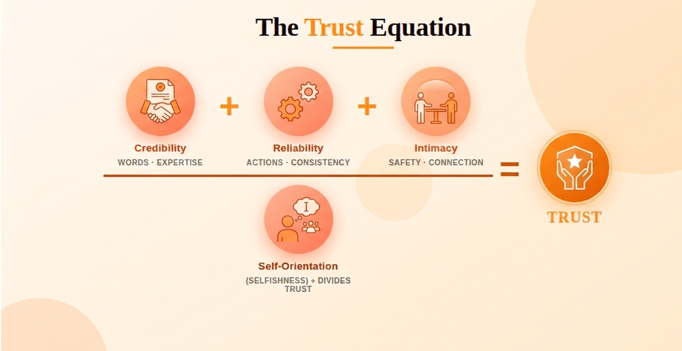
What this means in practice:
- Credibility: Do others believe in your expertise and judgement?
- Reliability: Do you consistently follow through on commitments, large and small?
- Intimacy: Do partners feel psychologically safe working with you?
- Self-Orientation: The divisor. Are you visibly serving the shared mission, or primarily serving your own/your organisation's interests?
A leader who appears self-interested will undermine collaboration more quickly than a less-experienced leader who is clearly committed to the collective goal.
2. Start with small wins
Trust typically starts at a low baseline when partners have no or limited history together. The antidote is a deliberate cycle of small wins: modest, low-risk, visible successes that build credibility, confidence and momentum before tackling harder challenges.
In Wisbech, Cambridgeshire, a coalition of cross-sector partners began with something as concrete as renovating a community centre. That shared success - visible, achievable and uncontroversial - generated the relational capital needed to pursue far more complex regeneration goals.
How to apply this:
- Open collaborations by identifying one realistic, time-bound objective that all partners can deliver
- Celebrate and communicate early wins internally and externally; they signal to sceptics that the partnership works
3. Define the shared problem from the outset
One of the key takeaways from our interviews with senior government leaders was this: trust accelerates fastest when all partners agree on the problem they are actually trying to solve before debating solutions.
As one government leader put it in our GGF report: "I started the discussions by saying: let's define the problem. It took a significant amount of time to reach an agreement, but once that was agreed, everything else became so much easier, and there was trust at subsequent meetings."
A shared diagnosis creates shared ownership. Without it, partners may use the same words and mean entirely different things, a quiet source of friction that compounds over time.
4. Make informal communication routine
The shift to hybrid and distributed working has reduced the opportunities for spontaneous, low-stakes interactions: the corridor conversation, the knock on the office door that historically facilitated natural collaboration. Leaders need to recreate these intentionally, more often.
The digital tap-on-the-shoulder principle: Use messaging platforms and informal channels for ad hoc, non-threatening check-ins. A short, friendly message outside a formal meeting cycle signals personal investment in the relationship, not just the project.
What good practice looks like:
- Set explicit norms early about how partners will communicate informally, not just formally
- Model the behaviour yourself. Send the occasional unscheduled message that isn't agenda-driven
- Create space at the start of meetings for personal connection before moving to business
5. Take the plunge on information sharing
Withholding information protects organisations in the short term and damages trust in the long term.
When organisations communicate openly, including complexities or uncertainties, they signal an honest, transparent commitment to the shared mission. San Francisco's approach to its homelessness crisis offers a compelling example. By bringing multiple agencies and civil society organisations together around a shared dataset, partners were able to collectively define the problem before designing solutions. The act of sharing information became an effective trust-building intervention.
What this means for leaders:
- Define the problem together before proposing solutions: shared diagnosis creates shared ownership
- Acknowledge openly what your organisation doesn't know or can't do alone
- Treat transparency about weaknesses as a strength, not a liability
The caveat: information sharing requires clearly agreed boundaries and governance frameworks. But the default should be openness, not restriction.
6. Invest in boundary-spanning capability
The GGF report found that countries making cross-sector collaboration part of their institutional DNA understand that trust is "capital that we hold on to, and try not to squander". Trust travels through people. Specifically, it travels most effectively through leaders who have credibility and relationships across multiple sectors, what researchers call boundary spanners.
Two ways to develop boundary-spanning capability:
- Value social capital as a leadership asset: when building teams or appointing collaboration leads, prioritise candidates with broad cross-sector networks alongside technical expertise
- Use secondments and exchanges: structured exchanges between sectors (NHS and civil society, government and business) are among the most effective known mechanisms for dismantling stereotypes and building genuine mutual understanding
The bottom line for senior leaders
Ultimately, trust and shared alignment turn collaboration from a procedural formality into a driver of results. When partners define problems together, understand one another’s constraints and operate with openness, and commit to shared goals rather than advancing isolated agendas, they move faster and deliver outcomes with lasting impact. Collaboration endures when it is trusted. And when it endures, it delivers.
Ready to become a boundary-spanning leader? Explore our experiential leadership programmes designed to build the collaborative skills, strategic insights, and cross-sector networks you need to confidently build trust across boundaries.
Written By:
As a Communications Executive, Abhushan supports the Marketing team in engaging its members and key audiences through the WIG monthly newsletter, website and multimedia content.
Abhushan has a decade of experience in journalism and over five years of expertise in development communications. Before joining WIG, he handled communications for various intergovernmental and non-profit agencies, including RIMES, UNDP Nepal, and BBC Media Action Nepal. Abhushan recently graduated with a joint Master's in journalism, media, and globalisation from Aarhus University in Denmark and the City University of London.
Outside the office, Abhushan loves to bike, play tennis and football. He also loves to cook, travel and explore new cultures.